How to Learn Division: A Clear Guide for Beginners
Learning division begins with understanding that it is the process of splitting a number into equal parts or groups. You divide one number, called the dividend, by another number, called the divisor, to find how many times the divisor fits into the dividend or how large each equal group will be.
Division is a foundational math skill that supports more complex concepts like fractions, decimals, and problem solving in everyday life. Gaining confidence with division helps improve overall math fluency and develops logical thinking that benefits many academic areas.
This article will explain basic division concepts, share effective methods to practice division, cover common challenges learners face, and suggest tools and activities that make mastering division both efficient and enjoyable.
Understanding the Basics of Division
What is Division and Why Does it Matter?
Division is splitting a quantity into equal parts or groups. For example, dividing 12 by 4 means splitting 12 into 4 equal groups, each containing 3. This operation is the opposite of multiplication and is essential for everyday calculations like sharing and measurements.
Understanding division helps strengthen numerical relationships and supports learning fractions and ratios later. It’s a concept encountered often, not just in math classes but in real situations like dividing food or cutting a rope into sections.
Key Terms: Dividend, Divisor, and Quotient
In any division problem, the number being divided is the dividend, the number you divide by is the divisor, and the answer is the quotient. For example, in 20 ÷ 5 = 4, 20 is the dividend, 5 the divisor, and 4 the quotient.
Recognizing these terms allows a clearer understanding of division problems and improves communication when solving them or asking questions.
- Dividend: number to be divided
- Divisor: number dividing the dividend
- Quotient: result of the division
How to Learn Division Procedurally
Using Repeated Subtraction and Grouping
One way to learn division is through repeated subtraction. This means subtracting the divisor repeatedly from the dividend until zero or a remainder is left, counting the number of subtractions to get the quotient.
This method helps visualize division as sharing or grouping and builds a strong conceptual foundation before moving to standard algorithms.
- Start with the dividend
- Subtract divisor repeatedly
- Count subtractions for quotient
- Note remainder if any
Learning Long Division Step-by-Step
Long division breaks down division into manageable steps using place value. Start by dividing the leftmost digit(s) of the dividend by the divisor, multiply the quotient digit by the divisor, subtract, then bring down the next digit.
Practicing long division enhances accuracy with larger numbers and introduces decimals or remainders.
- Divide the first digit(s)
- Multiply and subtract
- Bring down next digit
- Repeat until done
Common Challenges When Learning Division
Dealing with Remainders and Zero
Remainders occur when the dividend is not evenly divisible by the divisor. Understanding what a remainder means and how to interpret it (as leftover, fraction, or decimal) can be challenging at first.
Additionally, division by zero is undefined, and learners should recognize this to avoid mathematical errors.
- Remainder means leftover quantity
- Convert remainders to decimals or fractions
- Division by zero is not possible
Confusing Division with Multiplication
Since division and multiplication are inverse operations, some learners mix up when to multiply or divide, especially in word problems. Reinforcing their relationship helps clarify when to use division.
Practicing multiplication tables alongside division builds fluency and reduces this confusion.
Tools and Resources to Practice Division
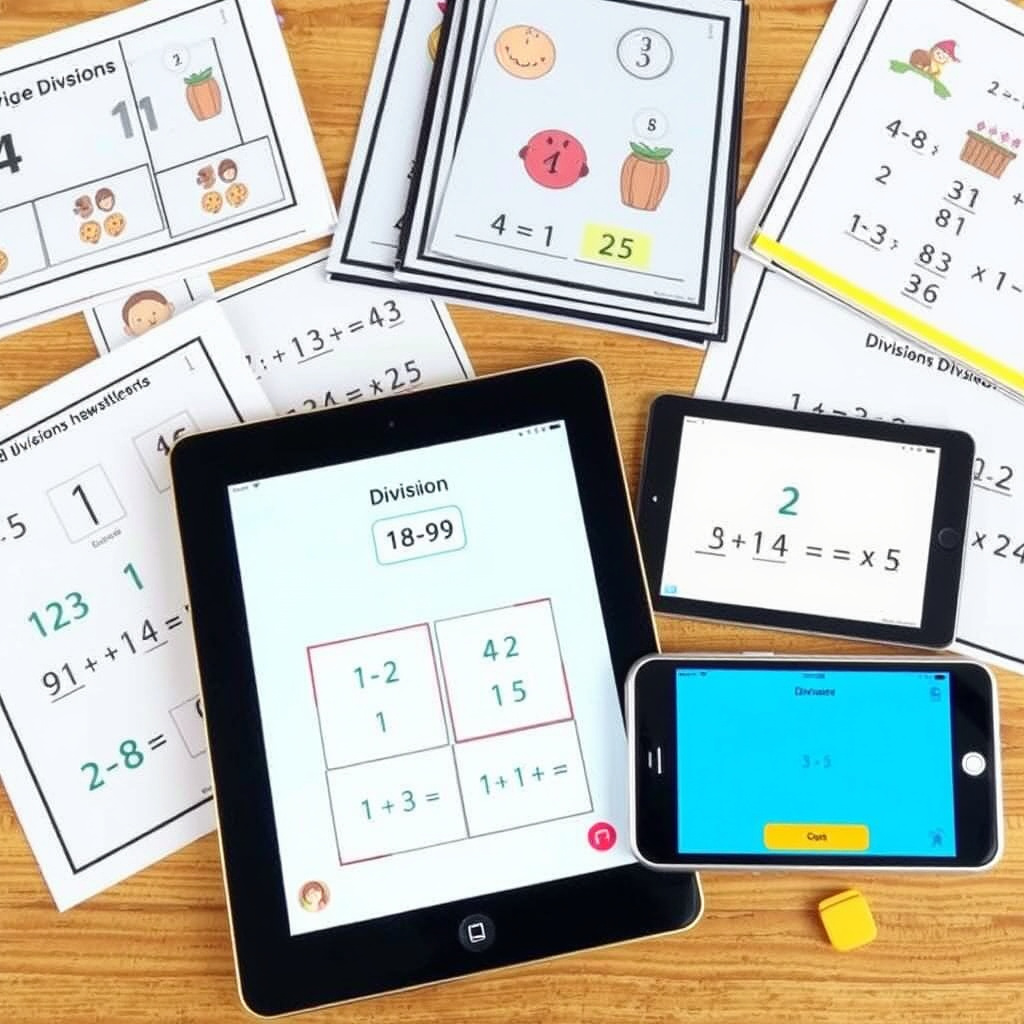
Using Visual Aids and Games
Visual aids like pie charts or grouping objects can make division tangible. Interactive games that require dividing to advance motivate learners and make practice enjoyable.
These tools reinforce basic division techniques by providing visual confirmation and practice in multiple formats.
- Block manipulatives for grouping
- Online interactive division games
- Color-coded division charts
Worksheets and Practice Problems
Regular practice with worksheets suited to skill level builds speed and confidence. Problems that gradually increase in difficulty support steady progress.
Practice should include straightforward computations as well as word problems to develop problem-solving skills.
- Start with simple division facts
- Include word problems for context
- Use answer keys for self-checking
Applying Division to Real-Life Situations

Division in Everyday Scenarios
Division helps when sharing items equally, budgeting money, cooking with recipes, or measuring distances. Recognizing these occasions connects abstract math to daily life.
Practicing division through practical tasks strengthens understanding by showing its relevance beyond school.
- Sharing snacks equally
- Splitting bills
- Adjusting recipe quantities
Using Division in Various Professions
Many careers like carpentry, engineering, retail, and finance regularly use division to calculate quantities, prices, or measurements. Early mastery prepares learners for these real-world applications.
Encouraging learners to notice and predict division problems they encounter builds curiosity and skill.
Tips to Strengthen Division Skills

Practice Consistently with Varied Problems
Regular daily practice improves speed and accuracy. Mixing types of division problems prevents memorization without understanding and helps with flexible thinking.
It’s beneficial to revisit foundational concepts alongside new challenges to build durable skills.
- Use flashcards for quick drills
- Try word problems for application
- Check answers and learn from mistakes
For a detailed mathematical overview, learn more about division from this comprehensive Wikipedia article. division.
Seek Help and Use Technology
When stuck, asking teachers or peers for explanations clarifies difficult points. Technology like apps and online tutorials can offer step-by-step guidance tailored to individual needs.
Using such resources fosters independent learning and maintains motivation.
Types of Division Methods Compared
Here’s a quick comparison of popular division approaches to help you find the best fit for learning.
| Method | Best For | Complexity Level | Tools Needed |
|---|---|---|---|
| Repeated Subtraction | Beginners understanding division concept | Low | Basic counting tools |
| Long Division | Working with multi-digit numbers | Medium | Paper and pencil |
| Division with Remainders | Intermediate learners | Medium | None |
| Using Technology (Apps) | Motivated, tech-savvy learners | Variable | Tablet or computer |
| Visual Grouping | Young children or visual learners | Low | Manipulatives or drawings |
Frequently Asked Questions
What is the easiest way to start learning division?
Beginning with repeated subtraction or dividing objects into groups helps build a visual and conceptual understanding before moving to written algorithms.
How do I handle division problems with remainders?
Recognize the remainder as what’s left after dividing evenly, and depending on the problem, it can be expressed as a leftover number, fraction, or decimal.
Why is long division important to learn?
Long division allows breakdown of larger numbers into manageable steps, helping solve division problems that aren’t simple to do mentally.
Can technology replace traditional division practice?
Technology can enhance learning with interactive tools, but it should complement—not completely replace—traditional practice and conceptual understanding.
How often should I practice division to get better?
Short daily practice sessions, even 10-15 minutes, improve retention and speed better than infrequent long sessions.
Key Takeaways
- Division splits numbers into equal groups or parts.
- Repeated subtraction and long division build strong foundational skills.
- Practice with varied problems and real-life examples improves understanding.
- Using visual aids and technology can support learning effectively.
Conclusion
Mastering division involves starting with a clear grasp of what division represents—splitting a number into equal parts—and practicing methods like repeated subtraction and long division to build confidence. Understanding key terms such as dividend, divisor, and quotient anchors one’s learning, while addressing common challenges like remainders ensures readiness for more advanced math. Consistent practice across different problem types reinforces these skills and makes division second nature.
For learners beginning with division, approaches like repeated subtraction provide a simple entry point, whereas long division is essential for handling larger numbers and preparing for decimals and fractions. Visual grouping helps younger students or those who benefit from concrete representations. Technology, including interactive apps, suits motivated learners who want self-paced study. Each method offers unique strengths, so combining them based on individual needs creates a balanced, effective learning experience.
To move forward, invest time in daily practice, including both straightforward calculations and word problems to connect division to real life. Use visual tools and technology as supplements, and reach out for help when concepts become challenging. With steady effort and the right resources, division transforms from a mystery into a valuable, applicable skill that supports ongoing success in math and beyond.